
Introduction
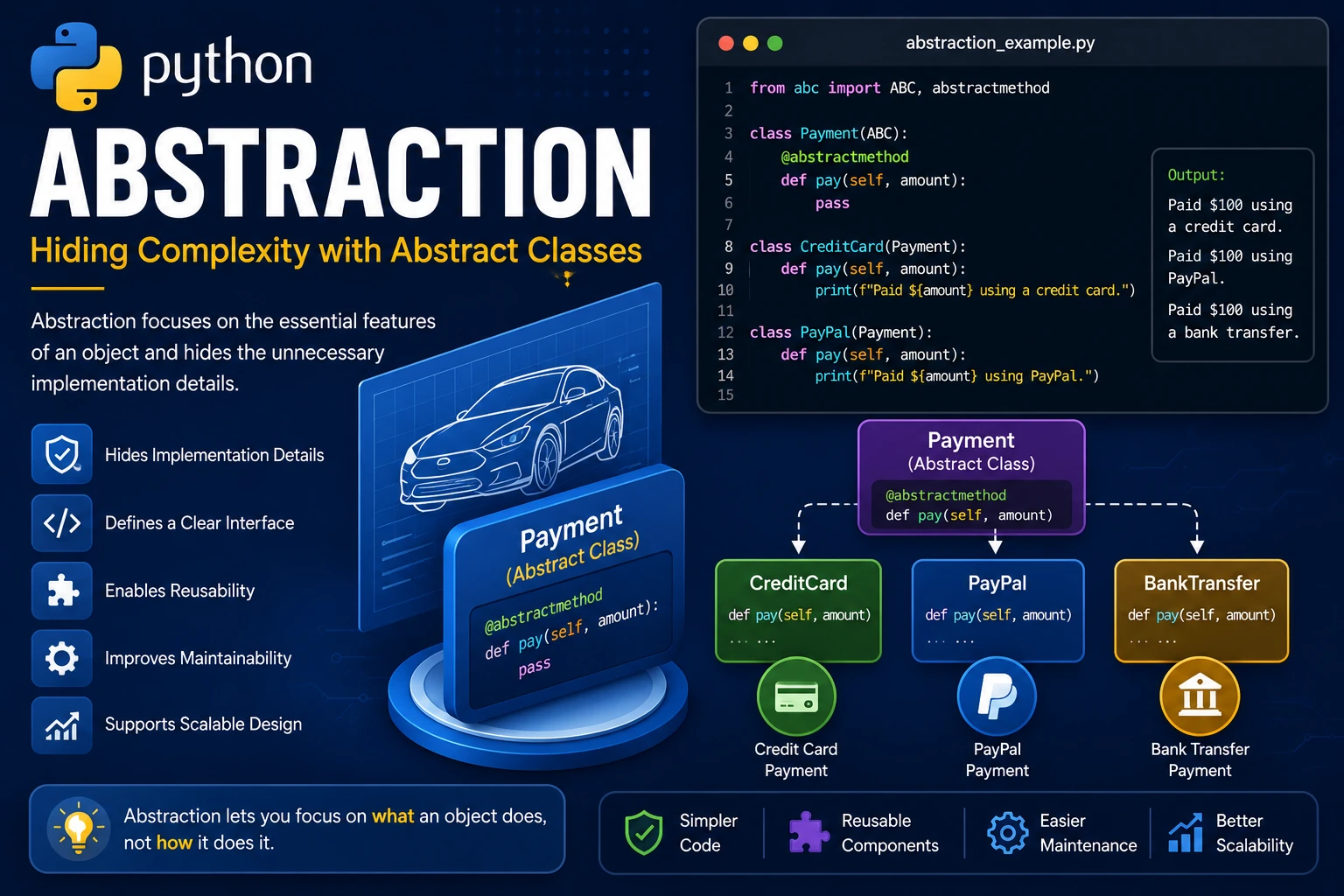
Abstraction is one of the four fundamental principles of Object-Oriented Programming (OOP). It focuses on hiding unnecessary implementation details while exposing only the essential features of an object. Instead of worrying about how something works internally, you simply use it through a well-defined interface.
For example, when you drive a car, you use the steering wheel, pedals and gear lever without needing to understand exactly how the engine operates. Abstraction in programming works in much the same way.
Why Use Abstraction?
Abstraction reduces complexity by separating what an object does from how it does it. This makes programs easier to understand, maintain and extend.
- Hides unnecessary implementation details.
- Simplifies complex programs.
- Encourages reusable code.
- Makes applications easier to maintain.
- Provides a clear interface for developers.
Abstract Classes
Python provides the abc (Abstract Base Class) module for creating abstract classes. An abstract class cannot be instantiated directly. Instead, it serves as a blueprint for other classes.
from abc import ABC

class Animal(ABC):
    pass
The Animal class defines a common base for all animal classes, but it cannot be used to create objects on its own.
Abstract Methods
An abstract method defines a method that every child class must implement. The @abstractmethod decorator is used for this purpose.
from abc import ABC, abstractmethod

class Animal(ABC):

    @abstractmethod
    def speak(self):
        pass
Any class that inherits from Animal must provide its own implementation of the speak() method.
Implementing an Abstract Class
A child class inherits from the abstract class and provides implementations for all of its abstract methods. Once every abstract method has been implemented, objects of the child class can be created normally.
from abc import ABC, abstractmethod

class Animal(ABC):

    @abstractmethod
    def speak(self):
        pass

class Dog(Animal):

    def speak(self):
        print("Woof!")

dog = Dog()

dog.speak()
Output:
Woof!
Multiple Child Classes
An abstract class can serve as the common blueprint for many child classes. Each child class implements the abstract methods in its own way.
from abc import ABC, abstractmethod

class Animal(ABC):

    @abstractmethod
    def speak(self):
        pass

class Dog(Animal):

    def speak(self):
        print("Woof!")

class Cat(Animal):

    def speak(self):
        print("Meow!")

class Duck(Animal):

    def speak(self):
        print("Quack!")

animals = [Dog(), Cat(), Duck()]

for animal in animals:
    animal.speak()
Output:
Woof!
Meow!
Quack!
Cannot Instantiate an Abstract Class
Because an abstract class is only a blueprint, Python does not allow you to create objects directly from it.
from abc import ABC, abstractmethod

class Animal(ABC):

    @abstractmethod
    def speak(self):
        pass

animal = Animal()
Output:
TypeError:
Can't instantiate abstract class Animal
with abstract method speak
When Should You Use Abstraction?
Abstraction is useful whenever several classes share common behavior but each class must provide its own implementation. It defines a clear contract that every child class must follow.
- Creating frameworks and reusable libraries.
- Designing large object-oriented applications.
- Enforcing consistent interfaces.
- Reducing duplicated code.
- Making projects easier to extend.
Real-World Example
Suppose you are developing a payment system for an online store. Every payment method processes payments differently, but they all share the same pay() interface. An abstract class ensures that every payment method implements this function.
from abc import ABC, abstractmethod

class Payment(ABC):

    @abstractmethod
    def pay(self, amount):
        pass

class CreditCard(Payment):

    def pay(self, amount):
        print(f"Paid ${amount} using a credit card.")

class PayPal(Payment):

    def pay(self, amount):
        print(f"Paid ${amount} using PayPal.")

class BankTransfer(Payment):

    def pay(self, amount):
        print(f"Paid ${amount} using a bank transfer.")

payments = [
    CreditCard(),
    PayPal(),
    BankTransfer()
]

for payment in payments:
    payment.pay(100)
Output:
Paid $100 using a credit card.
Paid $100 using PayPal.
Paid $100 using a bank transfer.
Advantages of Abstraction
- Hides unnecessary implementation details.
- Provides a simple and consistent interface.
- Encourages reusable code.
- Improves maintainability.
- Reduces code duplication.
- Makes large applications easier to organize.
- Enforces consistent behavior across related classes.
Best Practices
- Create abstract classes only when multiple child classes share common behavior.
- Keep abstract methods focused on defining the required interface.
- Allow child classes to implement their own internal logic.
- Combine abstraction with inheritance and polymorphism for clean object-oriented designs.
- Avoid creating unnecessary abstract classes for very small projects.
Summary
Abstraction hides implementation details while exposing only the features that users of a class need to know. Python supports abstraction through the abc module, allowing developers to create abstract classes and methods that define a common interface for related classes. Together with encapsulation, inheritance and polymorphism, abstraction forms one of the four core principles of Object-Oriented Programming and helps build scalable, maintainable and professional Python applications.
Examples
The following examples help reinforce the concepts explained in this lesson.
<!DOCTYPE html>
<html>

<head>

<title>My First Page</title>

</head>

<body>

<h1>Hello World</h1>

</body>

</html>
💡 Pro Tip
Practice every concept immediately after reading it. Learning by doing is the fastest way to master HTML.
⚠ Common Mistake
Do not simply copy code examples. Type them yourself and experiment with small changes.
Best Practices
- Write clean and readable HTML.
- Indent your code consistently.
- Use semantic HTML elements.
- Validate your HTML regularly.
- Test your pages in multiple browsers.
Frequently Asked Questions
Why should I learn HTML first?
HTML is the foundation of every website. Once you understand HTML, learning CSS and JavaScript becomes much easier.
Is HTML difficult?
No. HTML is considered one of the easiest web technologies to learn, making it an excellent starting point for beginners.